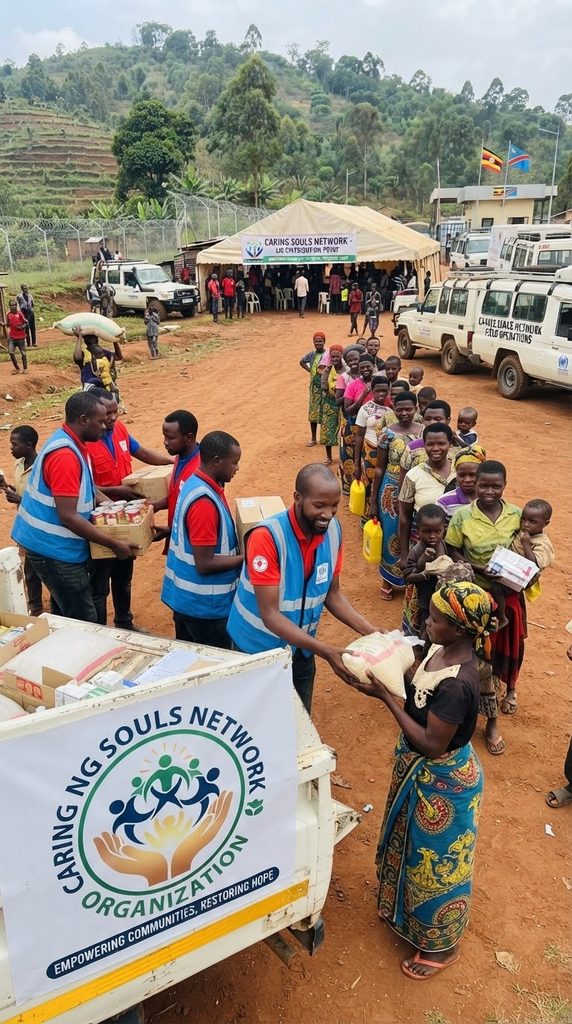
HELPING PEOPLE WHO ARE HELPLESS ON BORDER OF UGANDA AND CONGO
See new posts
@ABBEYSSENOwelThought for 1s
ABBEY SSENOGA uses the X handle @ABBEYSSENOwel. The account has zero followers and shows very limited activity, consisting mostly of brief replies along with an occasional retweet.
“hope to talk to you” -@ABBEYSSENOwel
Draft a story showing the hardship of people on the border of uganda and congo and they need help, like food, clothes, shelter, education, medical etcThought for 6s
The Dust Between Two Lands
Along the western edge of Uganda, where the hills of Kisoro and Kanungu meet the restless forests of eastern Congo, the border is not a clean line but a thin, trembling place. Paths worn by bare feet cross it every day. In the early morning mist, families emerge from the trees—mothers carrying children on their backs, old men leaning on sticks, teenagers with nothing but the clothes they fled in.
This is the story of one such family, and of the many who walk the same road.
Amina was thirty-two when the fighting reached their village near Rutshuru. One night the sky turned orange with fire. By dawn her husband was gone, taken by men with guns. She gathered her three children—eight-year-old Grace, five-year-old Joseph, and the baby, little Esther who still nursed—and they walked. For days they moved at night, hiding from patrols, drinking from muddy streams, eating what they could find or beg. When they finally crossed into Uganda at Bunagana, their feet were torn, their clothes were rags, and Esther’s cry had grown weak.
At the transit centre the ground was thick with people. Plastic sheeting and torn tarpaulins stretched over poles formed rows of temporary shelters that leaked when the rains came. Families slept shoulder to shoulder on thin mats or bare earth. Amina was given a space the size of a small blanket for all four of them. At night the children shivered. In the day the sun turned the air heavy and still.
Food arrived in careful, insufficient portions. Once there had been fuller rations; now many received far less—sometimes only a portion of maize and a handful of beans that had to last days. Amina measured the grain carefully, giving more to the children and taking the least herself. Grace’s cheeks grew thinner. Joseph’s energy faded until he no longer ran with the other boys. The baby’s arms and legs were stick-thin; her eyes looked too large for her face. Health workers spoke of malnutrition and anaemia. Some children in the centre had already been lost to it.
Water was precious and scarce. Long queues formed at the few taps. Latrines were overcrowded and overused. The smell of the place clung to skin and clothes. Malaria moved quietly through the tents; fever came in waves. When Joseph’s temperature soared, Amina carried him to the small clinic. The nurses were kind but stretched thin—medicines ran low, beds were full, and the waiting lines never ended. They gave what they could and sent her back with instructions and hope.
Clothes were another quiet need. The children wore the same torn shirts and dresses day after day. When the nights grew cold, Amina wrapped them in the single thin blanket they had been given. Grace’s school dress, the one she had worn when they fled, was now faded and full of holes. There was no money for new ones, and little clothing arrived in the distributions.
Education felt like a distant dream. In the settlement areas further inland, classrooms existed but were crowded beyond capacity. Many children sat on the floor or outside under trees. Books and pens were few. Teachers were too few. Some children, like Grace, wanted desperately to learn—she still remembered the letters she had begun in Congo—but hunger and the need to help fetch water or firewood pulled them away. Others never started at all.
Shelter remained fragile. When families were eventually moved to settlements such as Nakivale or Kyangwali, they were given plots of land and materials if any remained. Many built their own small houses from poles, mud, and plastic. When the rains came hard, roofs leaked. When the wind rose, walls shifted. The elderly, the disabled, and women alone often struggled most, unable to build or repair what they needed.
Yet even in this hardship, small lights remained. Neighbours shared the last of their flour. Women formed quiet circles to watch one another’s children. A health worker remembered a child’s name. A volunteer teacher gathered a few boys and girls under a tree and began teaching the alphabet with sticks in the dirt. Hope lived in the stubborn decision to keep walking, to keep asking, to keep surviving.
Amina still dreams of a proper roof that does not leak, of a full meal that leaves her children full and strong, of medicine when fever comes, of clothes that fit and last, of a school where Grace can sit at a desk and learn without worrying about tomorrow’s food. She dreams of a place where the border no longer feels like the edge of the world.
These are the hardships carried by so many along the Uganda–Congo border: hunger that shrinks bodies, nights spent under inadequate shelter, illnesses that spread in overcrowded conditions, children growing up without steady education, and the daily search for the most basic things—food, clean water, clothing, medicine, and a safe place to rest.
They do not ask for luxury. They ask for enough to live with dignity. And they are still